Idiot librarian
Monday, 28 February 2011 @ 14:57
ARGHHH. Herein follows an anecdote about why people at the UL need to go on a textual studies course. I arrive in the map room and ask to consult the 1590 Saxton Atlas. I'm asked if I could use the facsimile. I say, well, ok. I go back to my desk, look up the facsimilie record, and it's for 1579. I return and say, I want to look at the 1590 text, so the facsimilie will not do. I add that I have already looked at the 1590 text in the Rare Books room, and need to compare them. 'But they are the same,' I am told insistently.
'Well, yes, but I'm looking for variants.'
'The only variant is the binding.'
'What, so you are telling me these copies are identical.'
'Yes'.
'No they're not. They can't be.'
'They are.'
'They're not. Printed texts are always different from each other.'
'What do you mean text - there is no text, just maps.'
'I know, I just mean text as in textual object.'
'So you know there's not any writing on the maps - are you thinking of Speed? Do you want Speed? [Funny question in itself]'
'No, I want Saxton.'
...
'Can I have a look at the 1590 Saxton?'
One argument later, and it turns out that the item is listed incorrectly anyway and they only have the 1579 copy.
FFFFMMMMLLLLL
Labels: cambridge, reading, renaissance
Historical Shakespeare.
Tuesday, 27 April 2010 @ 23:57
How politically charged can drama be? A lot we like to think - satire has always been a medium of protest and reform in the arts. Since 1968 the active role of censorship was dissolved with the introduction of the Theatres Act, which removed from the Lord Chamberlain the role of discriminating between texts, and since well before then even, we have been accustomed, in a society which increasingly champions 'free-speech', to not having our rights to expression limited.The Renaissance theatre however, was radically different. In 1647, a Puritan government stopped all theatre, worried about the state of the degraded theatres and those who frequented them. The dramatic zeitgeist of Shakespeare's world was just as highly charged, but with a deep complexity running through it. Here, drama was not absolutely forbidden, but it was subject to censorship, and to a set of received wisdoms about what a play could or could not contain. Involved in a constant dialogue of negotiation, the Elizabethan stage particularly was an arena of political power, which at once threatened and confirmed the monarch's power. I'll consider (briefly), how Shakespeare's plays were involved in this complex positioning.
Ben Jonson observed of Shakespeare that he was 'not of an age, but for all time.' Do historicist critical approaches to Shakespeare undermine Jonson's sentiments?
Jonson's line, from an Epistle in the First Folio, presents us with a binary choice - Shakespeare is either grounded in his time, or transcendentally applicable to any time. But the interrogation of Shakespeare's cultural, economic, and political background doesn't have to be a divisive issue - the study of Shakespeare in his 'age' can be enlightening not just on the text situated in its historical context, and also on our own reception of him. Brecht's engagement with Shakespeare was unashamedly historical - he insisted the minutiae of costumes be perfected to match contemporary specifications. The thinking was, the shock of this spectacle would lead act as the verfremdungseffekt, forcing us not only to look critically at the powerplays of the narrative, but also at our own political positions. By emphasising the historical, we at once create a more distant observational point from which to make judgements, whilst simultaneously bringing us closer to an integrated, understanding of Shakespeare's, and our own, societies.
Since we started with the Lord Chamberlain, it might be worth taking him as a departure. The Lord Chamberlain, a prviledged and senior position in the Elizabethan Privy Council, was a powerful figure, and it was the Master of the Revels, a position under the Lord Chamberlain's command, that was responsible for the prevention of seditious drama on the Elizabethan stage. In A Midsummer's Night Dream, Philostrate who takes that role, the 'usual manager of our mirth.' His place is explicitly made as Master of the Revels in the play's dramatis personae, but the same figure appears through Hamlet, who stages his 'Mouse-Trap' play, in an attempt to discover the proof of the King's deceit:
King: Have you heard the argument? Is there no offence in't?Hamelt proclaims the play's innocence, knowing full well its dangerous content, and says as much in a witty play on the word jest - for as much as the play is a revel, it's also a poison that may be 'in-jest'ed, just as the poison on the stage is. The play is a radical space, where the revolutionary material on stage is a clear inditement of the King's guilt, whilst it also pleads its innocence, maintaing that, as a fictive arena, nothing on the stage should be taken too seriously.
Hamlet: No, no; they do but jest, poison in jest; no offence i' th' world.
But that's exactly what does happen throughout the Elizabethan period. Richard II, probably first came to the stage in 1595. Chronicling the deposition of the incumbent King by the rebel Bolingbroke, the play is, of all the histories, probably the most politically loaded in terms of its content. Shakespeare seems to be aware of this. The deposition scene, so crucial to the play, does not appear until the fourth quarto, which is published in James 1'st reign, clearly too suggestive for Elizabeth's stage. And yet, the play maintained the actual murder of the King throughout. That the deposition scene was censored and not the actual murder goes some way to proving just how dangerous symbolism in Elizabethan England could be, the performative act of deposition somehow as dangerous as the performances which were held on the stage. There is also some evidence for Shakespeare's careful editing of the play as he constructed it. In Richard II, Shaespeare has John of Gaunt pronounce a distinctly pro-monarch soundbite, which has no basis in the Holinshed source of the play:
Let heaven revenge; for I may never lifeAnd well he does to be on his guard, because there are certainly resonances of Eliabeth's rule throughout the text. After the death of Gaunt, Shakespeare has Lord Willoughby complain of the taxation on the land:
An angry arm against his minster
And daily new exactions are devis'dThe use of that word 'benevolences' refers to a specific type of tax, which sits anachronistically in the play - benevolences did not exist under Richard II, but under Elizabeth they were one of a number of taxes that led to charges of over-burdening the taxpayers and nobility of the land. Similarly, the 'Reports of fashion in proud Italy', that York complains about sit out of place in this chronicle - Only under Elizabeth did the Italian style become de rigeur for aspiring English dandies - during Richard's rule it was the French who were the model of taste in England.
As blanks, benevolences, and I wot not what
Of course, it would only be later that the true politicisation of Richard II would come to show, as the supporters of the Essex Rebellion paid for a private performance of the play, at a rate of some 40 shillings over the normal price. Elizabeth's political nickname was Richard II, and on a number of occassions we have records showing her councillors using the term. The Lord Chamberlain, considering his relative effecement in the court recorded that he was 'never one of Richard the Second's men', and the Francis Knollys, complained to Elizabeth's secretary that unless his good advice was taken, and he acknowledged, then the Queen would quickly find her court 'play the Parte of Richard the Second's men.' Both men were relations of Essex's. Elizabeth herself seems to have been concerned with the prospect of the play performed 40 times 'in open streetes and houses.' And there is a hauntingly ambiguous line in Richard the II, which retrospectively reads very suggestively. 'The king is not himself' we hear, when the king falls unwell. But perhaps, he is also Elizabeth. Essex was executed the same month as the play was performed for Essex's men.
In comparison, John Hayward, who wrote a chronicle in 1599 about the usurpation of Richard II, with a dedication to Essex was locked in the Tower for a period. Under James I, he was knighted. The vicissitudes of life under different morachs is clear - but so is the threat of the stage. It's seen as an immediate and present danger, in comparison to the mode of the chronicle. And the chronicle as a mode as important roots in Tudor history, where it represented not so much a way of seeking causal relations, but analogous ones. D. R. Woolf considers that Renaissance readers understood history not so much linearally as 'sideways.' Plays were important political tools, both of supporting the dominant culture, and of subverting them. And as Fitzdottrel cenfesses in Jonson's The Devil is An Ass, the play book often seems more 'authentic' than the chronicle. As the study of history, and the development of the artes historicae came about, there was a move to resite history as a study closer to how we see it today. These developments loosened rather than sharpened conceptual ideas of what history is, until the flashpoint of the late 1500's and early 1600's, when drama could act within ever looser boundaries with history plays.
If Richard II offers the most obvious view of the realpolitik associated with Shakespeare's drama, his first, last, and only Jacobean history play offers a more conceptual consideration of history. Originally called All Is True, Henry VIII even from its title asks considerable questions about what historical truth might mean. Does the title suggest that all is true, in a kind of arch-relativistic sense, or that all is true that is to be presented on the stage before the audience, in an antithetical statement. In one of the opening scene of the play, this problem manifests itself, as the Dukes of Norfolk and Buckingham discuss the recent peace-making at the Field of the Cloth of Gold. From the beginning we are wary - Buckingham states that 'an untimely auge' prevented him from appearing, though we know he was present in reality. And Norfolk's description of the event is a complexly ambiguous piece, which reveals further intricacy each time we read it, an artful piece of time-release poetry', and Julia Gaspar aptly puts it.
Consider the two monarchs in the Field:
The two kingswhat Norfolk creates is a dazzling piece of relativism, the two kings set off against each other in a feedback loop of mutual lustre. 'As presence did present them both', immediately conveys a sense of contingency to the laudatory tone of Norfolk, and the sense that the description he offers sits in a kind of vacumn. And the high praise offered soon falls flat. We hear how the talks have been a failure, the King of France moving away from them, and even Norfolk alters his mind, admitting:
Equal in lustre, were now best, now worst,
As presence did present them: him in eye
Still him in praise; and being present both,
Twas said they saw but one
Grievingly I thinkA 'fresh admirer' of what he saw, Norfolk's admiration retrospectively modulates its sense, from an appreciation of awe, to a juxtaposition of reality and dream. Shakespeare makes a reference back to the contingency in the details of the report as well by playing a clever sonic trick in the opening description of the scene:
The peace between the French and us not values
The cost that did conclude it.
Those suns of glory, those two lights of men,I think this is a subtle and playful retrospective. Shakespeare visually and phonically creates the suggestion, between 'Andren' and 'Arde' of Arden, the pastoral forest of play of As You Like It. Another forest in Warwickshire, transported to France, the Arden forest seems an appropriate look back to his former work, and to the dangers of placing too much faith in rigid, objective, realities. Especially on the page, the dash falling after 'Arde' seems to make it unfinished, calling for the final consonant which would make it familiar to Shakespeare's readers.
Met in the vale of Andren.
NOR: 'Twixt Guynes and Arde -
In case you hadn't figured it out, I just wrote this as a bit of revision, and it's now midnight, so I'm stopping. It was fun while it lasted though. if you get this far, have a cookie. Good night!
Labels: renaissance, revision, Shakespeare
William Kemp day
Tuesday, 20 April 2010 @ 13:13
Today I want to pay tribute to William Kemp, an early modern actor who was contemporarily, incredibly popular. A clown character, his parts were famous draws for audiences, and he was renowned for 'stealing the show' on a number of occassions. A title page in the work A Knack to a Know a Knave indicates the substantial draw he held not just for theatregoers, but also within the wider cultural milieu. A composer of jigs (Kemp was also a dancer), he is nonetheless best remebered as the inheritor of the previous epochs king clown, Richard Tarlton, of the Queen's Men, and for his involvement in the Lord Chamberlain's men, the troupe which, amongst other illustrious dramatists, will inevitably and eternally, be best remebered as William Shakespeare's gang.So, Kemp is a big deal. I'm just going to pick up on probably the best thing (subjective) he ever did, and, I might add, anyone ever did. Not content with playing clowns or composing jigs, Kemp had a masterstroke. Why not go on tour? But would a simple tour be enough for Kemp? Oh no. A self-publicist as well, and famous for his engagement with audiences, a simple tramp through England wouldn't really do it. So what does Kamp decide to do?
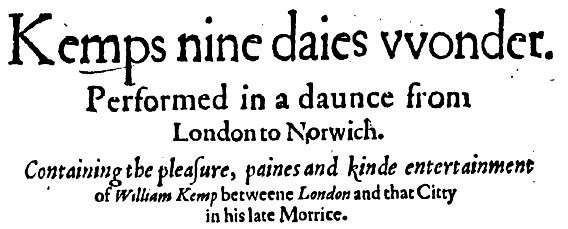
He spends nine days (with considerable breaks - clown he may be, athlete he is not) travelling from London to Norwich. It's worth adding that, counter to today, where Norwich would not be a remarkable entry in a list of, 'least remarkable places in Britain', Norwich in the late Elizabethan period was England's second city. So a pilgrimage between the two most important cities in England seems a good idea - plenty of urban culture vultures to appeal to for support. But Kemp goes one better.
He does the journey on foot. But instead of walking, he morris-dances. The whole way.
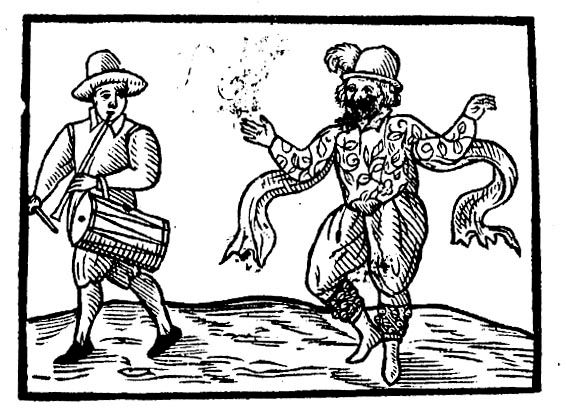
There he is, kitted out in all the latest gear, with bells on. No, literally, with bells on. Note that he doesn't really have a think, pubic-hair-like beard, it's just the fault of the Bodleian's copy of Kemp's record of the event. He dedicates it to Queen Elizabeth, which is thoughtful, because, along with her virginity, the cult of Gloriana, and a bit of a shine for the Earl of Essex, Elizabeth will always be remebered for her insatiable appetite for morris dancing. If the idea itself wasn't bizarre enough (and perhaps if it isn't, you can suggest something to trump Kemp's dance-a-thon) his documenting of the event is equally profound. I enclose a section from his ninth day, as he enters Norwich:
It was the mischance os a homely maide, that belike, was but newly crept into the fashion of long wasdted peticotes tyde with points, & had, as it seemed but one point tyed before, and comming vnuckily in my way, as I was fetching a leape, it fell out that I set my foote on her skirts: the point eyther breaking or stretching, off fell her peticoate from her waste, but as chance was, thogh his smock were course, it was cleanely: yet the poore wench was so ashamed, the rather for that she could hardly recouer her coate again from vunruly boies, that looking before like one that had the greene sicknesse, now she her cheekes all coloured with scarlet. I was sorry for her, but on I went...
Absolute genius. William Kemp, we salute you. I dub the 20th of April Kemp Day from now until forever. Amen.
Labels: renaissance, William Kemp
Sir James George FrazerThe Golden Bough
April 2010 / May 2010 / June 2010 / July 2010 / August 2010 / September 2010 / February 2011 / April 2011 / August 2011 / September 2011 /
Messing with Illustrator / /homeless / The irony of househunting. / Househunting / Some old material / Favourite capture on Google Maps Street View / Idiot librarian / THIS IS NOT THAT DAY! / Confirmation (not religious) / love data? love data. /
Messing with Illustrator / /homeless / The irony of househunting. / Househunting / Some old material / Favourite capture on Google Maps Street View / Idiot librarian / THIS IS NOT THAT DAY! / Confirmation (not religious) / love data? love data. /
The title of this blog comes from a poem by Coleridge, A Wish: Wriiten in Jesus Wood, Feb. 10th, 1792, Plus most blogs are moans anyway. Including this one.
lol manuscripts
picture.

I'm a 23 year-old student in London Cambridge London, studying English Literature Law. It's hard to really think of anything truly personal
I can put here that might give you some idea of who I am, so I will just tell you that my favourite Shakespeare play is Richard II, my favourite chocolate bar is Snickers, and I have a bit of a thing for instant coffee, especially if someone else makes it for me.
I'm interested in Renaissance Literature, Higher Education policy, and libraries.
I'm completely in love with a Scottish girl.